
Payload vs Towing Capacity: Read GVWR, GAWR, GCWR, and the Door Sticker
Learn how payload, GVWR, GAWR, GCWR, hitch limits, and tongue or pin weight work together before choosing a diesel truck for a real trailer.
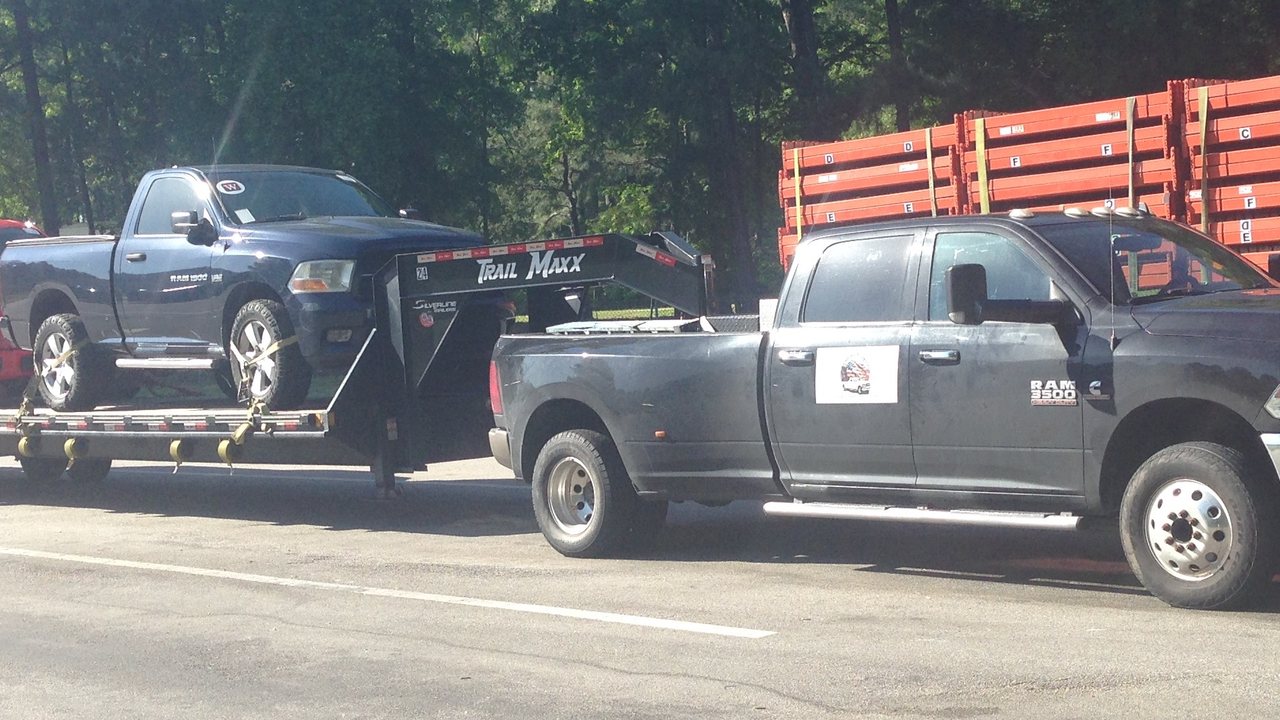
Cover photo: Ram 3500 Crew Cab Cummins towing a trailer. Photo by Bull-Doser, released into the public domain.
A truck’s advertised towing capacity does not apply to every example. The real limit comes from GVWR, front and rear GAWR, GCWR, trailer, tire, wheel and hitch ratings, plus payload after people and cargo are added.
Read the labels, model the loaded trailer, and verify both on a scale. No rating overrides another.
Know what each rating controls
GVWR — Gross Vehicle Weight Rating is the manufacturer’s maximum rated weight for the loaded truck. The truck, fuel, occupants, tools, accessories, bed cargo, hitch hardware, and trailer tongue or pin load all contribute to the truck’s actual weight.
GAWR — Gross Axle Weight Rating is the maximum rated load for an individual axle. The certification label normally identifies separate front and rear values. Staying below GVWR does not guarantee that the rear axle is below its GAWR.
GCWR — Gross Combined Weight Rating is the maximum rated combined weight of the loaded truck and loaded trailer for the specified configuration. It does not replace the truck’s GVWR, either GAWR, or the trailer and hitch limits.
Payload or occupant-and-cargo allowance describes how much weight the truck can carry. On late-model pickups, the tire-and-loading label usually states a maximum combined weight of occupants and cargo for that vehicle as built. Dealer-installed and aftermarket equipment consumes part of that allowance.
Trailer rating is the manufacturer’s limit for a defined vehicle and hitch configuration. Cab, bed, drivetrain, axle ratio, engine, transmission, wheelbase, cooling equipment, hitch type, and other options can change it.
Read the labels on the truck you may buy
Open the driver’s door and photograph every certification, tire, loading, and modification label. Do not use a sticker photo from another listing. Record:
- VIN and model information;
- GVWR;
- front and rear GAWR;
- original tire sizes and cold inflation information;
- combined occupant-and-cargo allowance;
- any final-stage manufacturer or upfitter label;
- any label documenting altered capacity or completed equipment.
Then obtain the manufacturer’s towing guide or VIN-specific data for the exact truck. Verify axle ratio and installed factory equipment rather than decoding the trim name from memory.
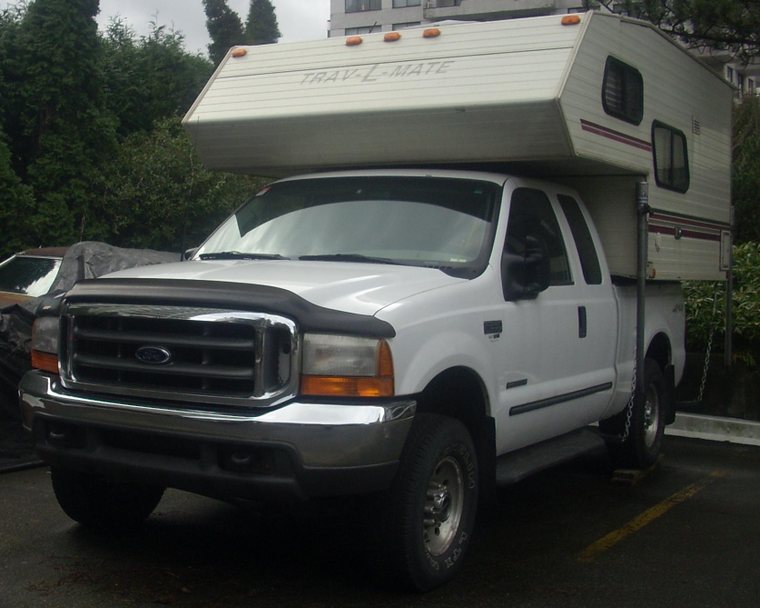
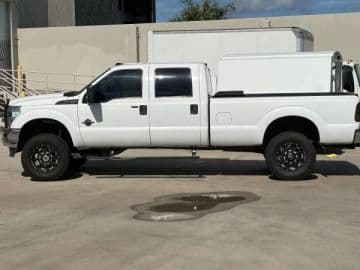
A Ford F-250 Super Duty diesel carrying a slide-in camper, an example of cargo that uses the truck’s payload and rear-axle capacity. Photo by Bull-Doser, released into the public domain.
Calculate what the truck will actually carry
Start with the occupant-and-cargo allowance on the truck, then subtract everything added to it:
remaining payload = label allowance − occupants − accessories − tools and cargo − hitch hardware − trailer tongue or pin load
Use measured or documented weights whenever possible. Include items that are often forgotten: running boards, replacement bumpers, winch, bed cover, toolbox, auxiliary tank and its fuel, air compressor, service body equipment, fifth-wheel hitch, pets, coolers, and recovery gear.
This worksheet creates a planning estimate. A scale provides the verification. The loaded truck must remain within GVWR, and each axle must remain within its own GAWR. Tires, wheels, suspension components, and the hitch must also be suitable for the actual load.
Tongue and pin load use truck capacity
A trailer does not place all of its weight on the trailer axles. Part of the load is carried by the truck through the receiver, gooseneck ball, or fifth-wheel hitch. That load consumes payload and usually adds substantial weight to the rear axle.
Do not use an empty or brochure tongue-weight figure as the final number. Batteries, propane, water, equipment, cargo location, and trailer modifications can change the loaded result. Measure the trailer in its travel-ready condition and follow the trailer and hitch manufacturers’ loading instructions.

A Chevrolet Silverado 3500 HD Crew Cab DRW towing a large travel trailer. Photo by DanTD, licensed under CC BY-SA 4.0.
This is why a dually can be useful even when two trucks advertise similar trailer ratings. A DRW configuration may provide a different rear-axle, tire, and payload package. Read when the extra rear tires pay off, then verify the exact labels instead of assuming every DRW has the same advantage.
Weigh by axle, not only as one total
Use a certified public scale with the truck loaded as it will travel. A useful process is:
- Weigh the loaded truck without the trailer and record front-axle, rear-axle, and total weight.
- Connect the loaded trailer using the intended hitch setup.
- Weigh the complete combination with the truck’s front axle, rear axle, and trailer axle group on separate scale platforms when the facility allows.
- Compare actual truck weight with GVWR, each axle with its GAWR, and combined weight with GCWR.
- Compare the actual trailer and hitch loads with their manufacturer ratings.
For a weight-distribution hitch, follow the vehicle, trailer, and hitch instructions and evaluate axle loading after adjustment. Do not move cargo solely to make one number look better if the new position creates trailer instability or exceeds another rating.
Why tow-rating calculators can mislead
An online calculator is only as accurate as its inputs. Common mistakes include:
- entering trailer dry weight instead of loaded scale weight;
- using a maximum tow rating from a different cab, bed, or axle ratio;
- forgetting passengers, tools, hitch hardware, and accessories;
- checking GVWR but not rear GAWR;
- assuming air springs or upgraded tires increase manufacturer ratings;
- ignoring the receiver, ball, fifth-wheel, or gooseneck rating;
- comparing a modified truck with factory data that no longer matches it.
Air springs, helper springs, and other suspension parts may change ride or level under load. They do not automatically rewrite the certification label or increase every other component’s rating.
Use ratings to choose the truck before buying
Build the load worksheet before contacting sellers. Ask for clear door-label photographs and reject listings that will not provide them. Compare candidates in the one-ton pickup inventory hub, but remember that model class alone does not establish payload.
Our guide to matching a diesel truck to real towing work can help define the shortlist. For trucks carrying cranes, compressors, service bodies, or extensive tools, the used mechanics truck checklist covers additional upfitter and mounted-equipment questions.
Payload and towing buyer checklist
- Photograph all labels on the exact truck.
- Confirm VIN, axle ratio, drivetrain, cab, bed, and hitch configuration.
- Obtain manufacturer data for that configuration.
- List every occupant, accessory, tool, and cargo item.
- Use realistic loaded trailer and tongue or pin weights.
- Check GVWR, front GAWR, rear GAWR, GCWR, trailer rating, and hitch rating.
- Verify tire and wheel suitability and condition.
- Inspect frame and hitch attachment points.
- Weigh the loaded truck and combination by axle.
- Leave practical capacity for real trips rather than planning directly to a limit.
Payload and towing capacity answer different questions, but neither works alone. The correct truck is the one that remains within every applicable rating when loaded for the real trip—not the one with the largest number in an advertisement.
Evidence
Sources
Primary references used to verify the regulatory and technical details in this article.
- 1. 2026 Ford RV and Trailer Towing GuideFord Motor Company
- 2. 49 CFR § 567.4 — Certification Label RequirementsNHTSA / Electronic Code of Federal Regulations
Inventory
Shop trucks from this story
Next steps